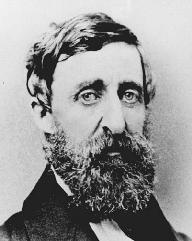
Henry David Thoreau
Personal Information
· I was born the 12th of July in 1817
· I was born in Concord Massachusetts
· I studied and graduated at Harvard University and Concord Academy
· I have written Walden and Civil Disobedience
· I have provided a new way of looking at life, and being able to stand back and decide what I was meant to live for.
Issues
· I was very much against slavery and having to be ruled and governed by an unjust government
· I believe that a person should stand up for what they believe in. A person should live their life the way they want it, and need not be bound by the rules of government, nor be afraid to by judged and just.
· I found my motivation by leaving to a cabin near a pond and experiencing nature firsthand, apart from the pressures of the world
Solutions
· I am able to say that my solution for slavery and an unjust government is to be just. As I once said, “Under a government that prisons any unjustly, the true place for a just man is also prison.”
Wordle
http://www.wordle.net/show/wrdl/2717529/Henry_Thoreau
Showing posts with label Abolitionism. Show all posts
Showing posts with label Abolitionism. Show all posts
Friday, November 12, 2010

Thursday, November 11, 2010
Wendel Phillips

Personal Background
- · I, Wendell Phillips, was born November 29, 1811
- · I died on February 2, 1884
- · I graduated from Harvard College in 1831 and then from Harvard Law School in 1833
- · I am a popular man because I was completely against slavery in a time when it was strong in the South
- I was a radical abolitionist and wrote many pamphlets on the matter
- · I was also pro women’s rights, and I supported temperance and labor reforms
- · After the Civil War, I worked to help African Americans get civil rights
- · My oratory skills helped me get supporters for my cause
Issues
- · I was completely for abolition
- · The slaves should have been freed earlier
- · I was motivated in my youth, by William Lloyd Garrison, to fight for abolition in the United States
- · As stated earlier, I was for women’s rights, labor reforms, and temperance
Solutions
- · To fight for abolition, I did what many anti-slavery people did and boycotted cane sugar and any cotton clothing, because they were made by slave driven plantations
- · I also wrote pamphlets and made many a speech on the topic to get people to support my cause.
- · I accumulated many followers for my troubles
- · I was unfortunately indicted in 1854 because of my participation in the attempt to break a fugitive slave, Anthony Burns, out of a Boston jail
Lyman Beecher

Personal Background
•I was born on October 12, 1775 in New Haven, Connecticut.
•I attended Yale in 1793 for my formal education.
•Some of my notable achievements include being asked to become the President and Professor of Theology at Lane Seminary, serving as minister at a Presbyterian church in East Hampton, New York, as well as serving at the First Church in Litchfield, Connecticut. Overall, I was known as a successful revivalist whose ideas many Americans could connect with.
•During my career, I defended Calvinist and Puritan Orthodoxy, supported the Temperance movement, attacked the practice of dueling, and voiced out against Liberals and Unitarians to preserve religion.
Issues
•Some of the issues I voiced my opinion on included the Temperance Movement, Abolition, the practice of dueling, and moral reform.
•I wholeheartedly supported the Temperance Movement and even published “Six Sermons on Intemperance.” As for Abolition, I support antislavery and gradual emancipation but not the extremes of Abolition that the students of Lane Seminary were for. I also believe that dueling is for the privileged upper class that believes they are above the law and morality.
•My main inspiration for everything I do is my religious beliefs. I was taught by Timothy Dwight, the president of Yale, and share his religious and social views.
Solutions
•[Temperance] My solution to the alcohol problem in America is for people to simply follow abstinence. I have given speeches and published Six Sermons on Intemperance in hopes of convincing the people to follow Temperance.
o The Temperance movement, as a whole, was successful and it did cut down on this country’s alcohol consumption. I like to think that I played a part as one of the leading voices for the movement.
•[Abolition] I favor gradual emancipation of slaves instead of immediate, but that isn’t my main concern. The students at Lane Seminary were way too concerned with Abolition and that took away from their studies.
o The students of Lane Seminary were not pleased with what the trustees and I told them so they left Lane Seminary and joined Oberlin College.
•[Dueling] I advocated voting duelists out of office. Dueling, in my opinion, is symbolic of the decline in social order which a republic needs to survive.
o This issue wasn’t that important to catch on nationwide.
•[Moral Reform] I urged a return to the ways that the Puritan founders of New England preached: laws against intemperance, Sabbath breaking, and other forms of immorality.
o I faced great opposition from Baptists, Methodists, Episcopalians, and Deists. In the end, Congregationalism was removed as the official church in Connecticut and my plans ended up failing.
Relationships to others
• There are very few that I would agree with completely, perhaps those that supported Temperance primarily.
• I do not get along with Charles Finney, Theodore Dwight Weld, William Lloyd Garrison, among other liberals, Unitarians, and Catholics.
~Shuipys

Arthur Tappan

Arthur Tappan
Personal Background Information:
I was born on May 22, 1786 in Northampton, Massachusetts.
I attended a town school until I was 15 years old. I was given a clerkship with Sewall & Salisbury, hardware and dry-goods in Boston.
For a time I sat under the preaching of William Ellery Channing.
I was an abolitionist.
Issues:
• American and Foreign Anti-Slavery Society
• Supports feminism
• Supports Women’s Suffrage
• After the Fugitive Slave Law was passed in 1840, I refused to comply with the law, and financially supported the Underground Railroad.
Solutions:
o I helped form the American and Foreign Anti-Slavery Society.
 A. Robles
Elizabeth Cady Stanton

- Born: November 12, 1815; Johnstown, New York
- Died: October 26, 1902; New York, New York
- I attended Johnstown Academy as a teenager; I studied Greek, Latin, and mathematics, which were normally subjects reserved for men. After I graduated, I attended the Troy Female Seminary.
- I married Henry Stanton, an abolitionist.
- I am a notable individual because I was the main author of the Declaration of Sentiments and organized the first women's right convention at Seneca Falls in New York.
Issues:
- I was involved in the temperance movement.
- I fought for women's rights.
- I was also an abolitionist.
Solutions:
- I founded the Woman's State Temperance Society with Susan B. Anthony.
- I attended the International Anti-Slavery Convention in London.
- I organized the Seneca Falls Convention.
- I drafted the Declaration of Sentiments, which demanded equal treatment of women.
I share friendships and similar values with Susan B. Anthony and Lucretia Mott. However, I would not enjoy conversing with Charles Grandison Finney; his preaching frightened me and lead me to fear damnation.
Lydia Maria Child

Background:
•Born- February 11, 1802 (Medford, Massachusetts)
•Died- October 22, 1880 (Wayland, Massachusetts)
•Attended public school and then seminary for a year
•Author of many books and magazines
•Abolitionist
•Owned a private school from 1825-1828 in Watertown Massachusetts
●Married David Lee Child in 1828
●I was influenced to be an abolitionist by William Lloyd Garrison
●I was made the executive committee of the American Anti-Slavery Society, I later became editor of the National Anti-Slavery Standard in 1840
Issues:
•I was mainly an abolitionist fighting to end slavery
●I am a journalist who wrote many articles to help abolish slavery
●I fought for women’s right as well Indians rights
●Many of my articles were banned because of my strong opinions against the government
Solutions:
●I want all people to be considered equal regardless of race, sex, or skin color which is seen in my article
●While serving as a member of the Anti-Slavery Society executive board I wrote many novels and journals to abolish slavery
●I believe that violence was not necessary in abolishing slavery
●Due to my work with the Indians rights movement the US Board of Indian Commissioners was formed
●Also due to my work with the Indian rights movement the subsequent Peace Policy was created
Relationships to others:
●I worked closely with Lucretia Mott on the Anti-slavery Society executive board to help abolish slavery
●I am a lifelong friend with Margaret Fuller
●Education-I feel that all people should be educated regardless of their skin color, gender, or race
●Utopian Communities- I feel that America should be turned into a utopia because we are all human, and all people are created equal
-Passialis
Subscribe to:
Posts (Atom)